

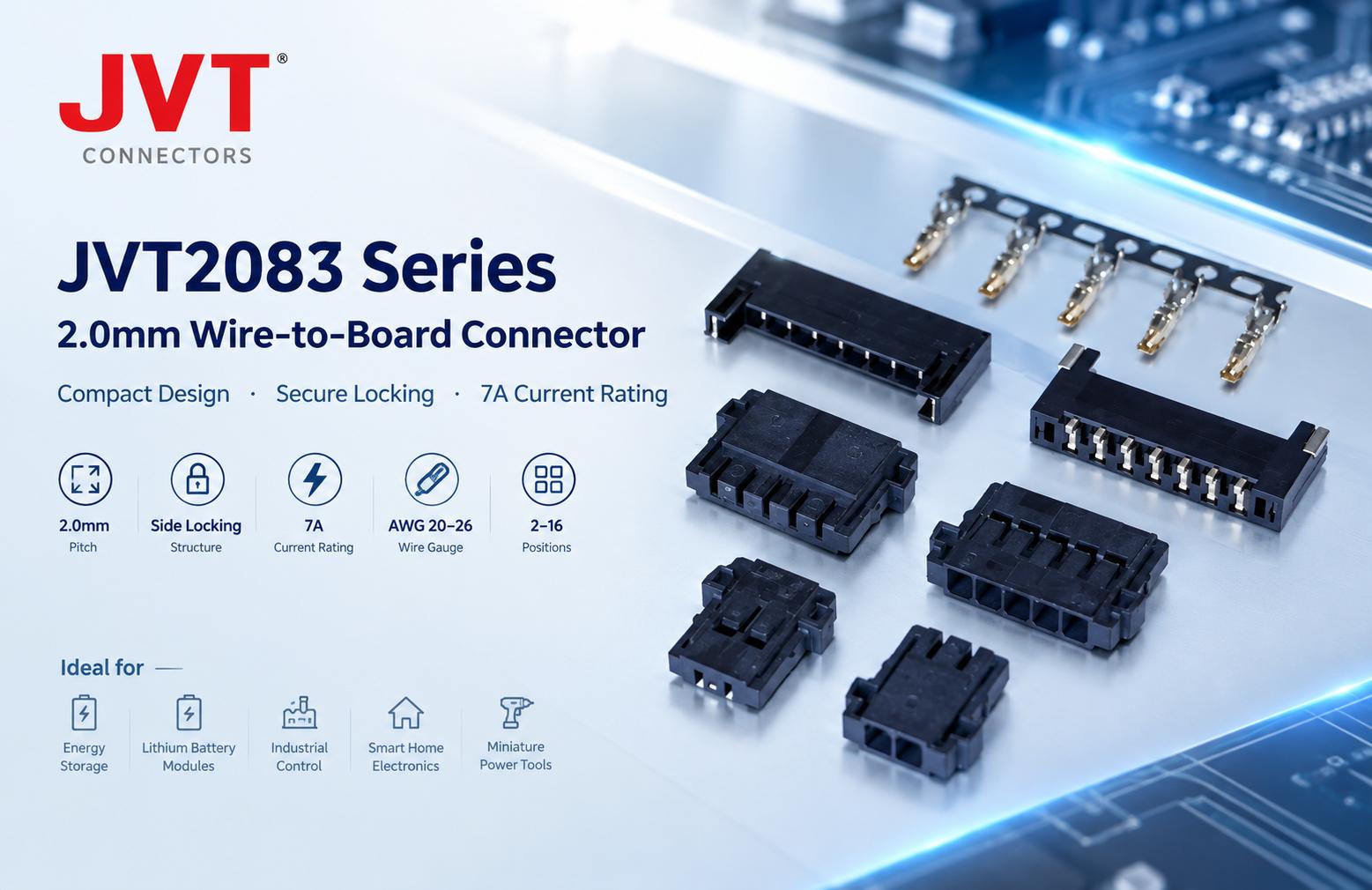
As electronic devices become smaller and more integrated, engineers need wire-to-board connectors that combine compact dimensions, secure connections, and reliable power transmission.
The JVT2083 series is a 2.0mm-pitch, side-entry wire-to-board connector featuring a locking structure designed to help maintain secure mating. With a rated current of 7A, compatibility with AWG 20–26 wires, and configurations ranging from 2 to 16 positions, the series provides a practical solution for space-constrained electronic assemblies.
It can be evaluated for applications in energy storage systems, lithium battery modules, industrial control equipment, smart home electronics, and miniature power tools, subject to the requirements of the specific application.
1. What Is a Wire-to-Board Connector?
A wire-to-board connector connects wires or cable assemblies to a printed circuit board (PCB), providing a detachable electrical interface for power distribution, signal transmission, or control circuits.
These connectors are widely used in electronic equipment where reliable internal wiring, convenient assembly, and efficient use of installation space are important. Typical application scenarios include:
- Energy storage systems: internal wiring for compatible control boards and electronic modules.
- New energy equipment: electrical connections within compact power and control assemblies.
- Lithium battery modules: connections between compatible circuit boards and auxiliary electronic components.
- Industrial control equipment: internal wiring for control boards and electronic modules.
- Miniature power tools: connections between batteries, switches, and motor control circuits, where the selected connector meets the required electrical and mechanical specifications.
Choosing the right connector requires evaluating its electrical ratings, mechanical structure, wire compatibility, and operating environment.
2. Key Features of the JVT2083 Series
Compact 2.0mm Pitch
The JVT2083 series features a 2.0mm pitch, making it suitable for electronic assemblies where PCB space and internal wiring layouts need to be carefully managed. Its compact configuration can help engineers optimize board layouts while maintaining a detachable wire-to-board connection. Confirm the connector dimensions, PCB footprint, mating height, and required clearances using the official product drawing.
Side-Locking Structure for Secure Connections
The JVT2083 series adopts a side-locking structure designed to improve mating retention. Its tactile mating feedback helps users identify when the connector has been properly engaged. The locking structure can help reduce the risk of accidental disconnection during handling and equipment operation. For applications exposed to vibration or movement, confirm retention performance through the relevant mechanical specifications and application testing.
7A Rated Current
The JVT2083 series has a specified rated current of 7A, making it a candidate for suitable power connection requirements within its specified operating conditions. Actual current-carrying performance depends on wire size, contact resistance, ambient temperature, the number of energized contacts, and heat dissipation. Review the manufacturer's current-rating conditions and derating information before use.
Compatible with AWG 20–26 Wires
The series supports AWG 20–26 wire sizes according to the supplied product information. Selecting the correct wire and crimp terminal is essential for stable electrical performance and reliable assembly quality. Check the approved wire range, conductor construction, insulation diameter, and crimping requirements against the applicable terminal specification.
Complete Connector Components
The JVT2083 series includes compatible PCB headers, wire housings, and crimp terminals. Configurations are available from 2 to 16 positions. Confirm the correct mating components and part numbers before ordering.
3. JVT2083 Technical Specifications
| Series | JVT2083 |
| Product type | Wire-to-board connector |
| Pitch | 2.0mm |
| Entry direction | Side entry |
| Locking structure | Side locking |
| Rated current | 7A |
| Compatible wire gauge | AWG 20–26 |
| Number of positions | 2–16 positions |
| Housing material temperature range | -40°C to +105°C, as specified in supplied product information |
| Available components | PCB header, wire housing, crimp terminal |
| Reference series | Molex 205338 family |
| Potential applications | Energy storage, lithium battery modules, industrial control, smart home electronics, miniature power tools |
Technical note: This table summarizes currently available information. Confirm rated-current test conditions, voltage rating, contact material and plating, complete assembly temperature limits, dimensions, and applicable certifications against the latest official datasheet.
4. How to Select the Right Wire-to-Board Connector
- Pitch: Pitch is the center-to-center distance between adjacent contacts. The JVT2083 series uses a 2.0mm pitch. Confirm that the connector matches the intended PCB layout and mating components.
- Current Rating: Check operating current, peak current, and current per contact. Review temperature-rise limits and derating requirements, especially when multiple contacts carry current simultaneously.
- Wire Gauge: Select a wire and crimp terminal combination within the approved AWG range. Incorrect wire selection or improper crimping can affect contact reliability and temperature rise.
- Number of Positions: The JVT2083 series offers 2–16 positions. Choose the configuration based on required circuits, available PCB space, and system wiring requirements.
- Operating Temperature: Confirm the operating temperature range of the complete connector assembly. Housing material temperature resistance does not automatically define the allowable operating temperature of every component or current rating at elevated temperatures.
- Locking and Mating Compatibility: Verify the mating header, housing, terminal, pin arrangement, orientation, and mechanical retention requirements. A shared pitch does not guarantee that different connector series are interchangeable.
5. Common Connector Selection Mistakes
- Choosing by size alone. A connector that fits the PCB may not meet current, temperature, or mechanical requirements. Check the complete product specification.
- Assuming the maximum current applies in every condition. Current ratings depend on defined test conditions. Wire size, ambient temperature, energized contact count, and heat dissipation may affect allowable current.
- Ignoring wire and terminal compatibility. Confirm approved wire range, insulation diameter, crimp specifications, and assembly tooling.
- Overlooking locking and mating compatibility. Verify matching components and mechanical dimensions. Do not assume similar-looking connectors can be directly substituted.
- Skipping application validation. Depending on the application, validation may cover contact resistance, temperature rise, mating retention, vibration, and other relevant performance requirements.
6. Applications of the JVT2083 Series
- Energy Storage Systems: The series can be evaluated for compatible electronic modules and auxiliary circuits where its electrical and mechanical ratings meet the application requirements.
- Lithium Battery Modules: The compact design can be considered for internal connections between compatible circuit boards and electronic components. Consider current demand, temperature, vibration exposure, and applicable system safety requirements.
- New Energy Equipment: The JVT2083 series provides a wire-to-board option for evaluation where space efficiency and secure mating are important.
- Industrial Control and Smart Home Electronics: The series can be considered for internal wiring in suitable control boards and electronic equipment, subject to environmental conditions and electrical requirements.
- Miniature Power Tools: Evaluate the series only after checking motor load, battery current, temperature rise, vibration exposure, and retention requirements.
Application suitability should always be determined by the specifications of the selected model and appropriate engineering validation.
7. JVT2083 and Molex 205338: What Should Engineers Compare?
The JVT2083 series is identified in the supplied product information as corresponding to the Molex 205338 family. When evaluating an alternative connector, engineers should compare the complete mating system rather than relying on pitch or external appearance alone:
- PCB footprint and dimensional compatibility
- Mating header and housing geometry
- Terminal design and approved wire range
- Current rating and electrical performance
- Material specifications and temperature limits
- Locking structure and mating retention
- Required reliability tests and certifications
A matching 2.0mm pitch does not establish complete interchangeability. Verify the exact part-number cross-reference and official drawings, then conduct fit, electrical, and mechanical validation before approving a replacement.
8. Request JVT2083 Product Information, Samples, or a Quotation
Looking for a compact 2.0mm wire-to-board connector with a locking structure for your next project? JVT can help you review available JVT2083 configurations and identify products for further technical evaluation.
Contact our team to request product datasheets and dimensional drawings, available header/housing/terminal combinations, samples for fit and performance evaluation, and project quotations.
Contact JVT for connector selection support, sample requests, or an RFQ.
Share your required current, wire gauge, number of positions, operating temperature, and installation constraints to help our team understand your project requirements.
Technical Disclaimer: All electrical ratings, dimensions, material details, temperature limits, certifications, and compatibility claims must be verified against the latest official product documentation. Application suitability and interchangeability should be confirmed through engineering review and appropriate testing.